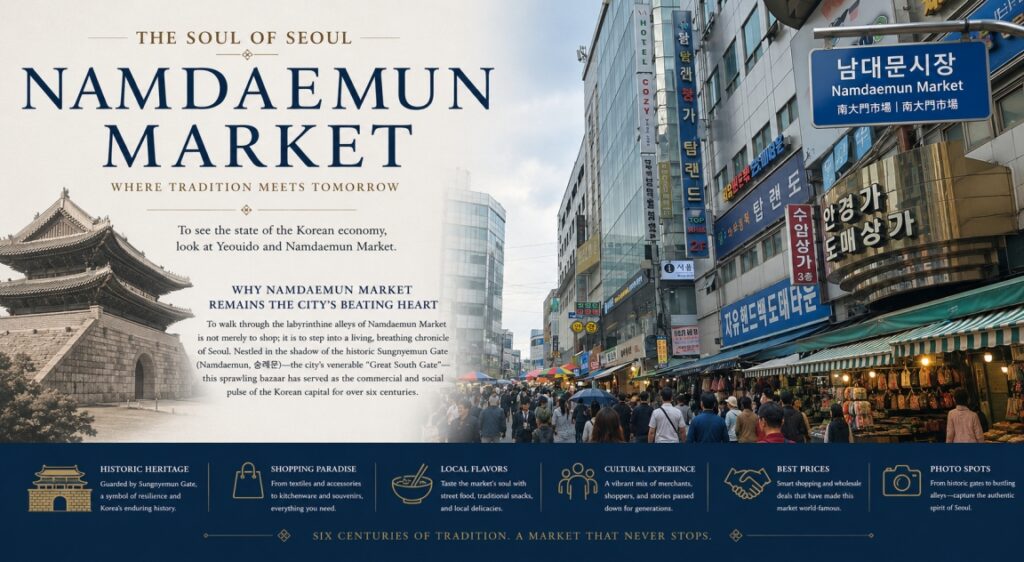
To see the state of the Korean economy,
look at Yeouido,
and Namdaemun Market.
Namdaemun Market is Seoul’s oldest and largest traditional market, offering more than six centuries of history, authentic Korean street food, local shopping, and cultural heritage beside the iconic Sungnyemun Gate (Namdaemun).
Why Namdaemun Market Remains the City’s Beating Heart
To walk through the labyrinthine alleys of Namdaemun Market (남대문 시장) is not merely to shop; it is to step into a living, breathing chronicle of Seoul. Nestled in the shadow of the historic Sungnyemun Gate (숭례문)—the city’s venerable “Great South Gate”(Namdaemun, 남대문)—this sprawling bazaar has served as the commercial and social pulse of the Korean capital for over six centuries.

The Joseon Era: A State-Engineered Economic Engine
While many marketplaces in history grew organically, Namdaemun market was emerged under the vision of the Joseon Dynasty. The commercial district around today’s Namdaemun Market traces its origins to 1414 (the 14th year of King Taejong’s reign), the market operated under the moniker Chilpae (the Seventh Precinct, 칠패).
Unlike the smaller, local markets that serviced residential neighborhoods, Namdaemun market evolved around government-controlled commercial districts. It was designed as a sophisticated logistical hub to support the central government. Its role was multifaceted:
- Centralization of Goods: The market functioned as the primary destination for regional tributes—the agricultural produce, medicinal herbs, and high-quality textiles sent from the provinces to the capital.
- Logistical Supremacy: Because it sat just inside the Sungnyemun Gate—the main southern entry point for travelers and trade caravans arriving from the southern provinces—the market became one of the principal gateways for goods entering Hanyang (old name of Seoul, 한양). It was here that the wealth of the Korean peninsula was filtered, sorted, and distributed before entering the walled city of Hanyang.
This state-sanctioned status meant that even in a strictly Confucian society, where merchants were officially viewed as the lower class than the elite (yangban, 양반), the traders of Namdaemun wielded immense economic influence, quietly pulling the strings of the capital’s daily functionality.

Modernization and the “Miracle on the Han river”
As Seoul hurtled toward modernization in the 20th century, Namdaemun Market weathered the turbulence of colonial occupation and the utter devastation of the Korean War. Following the conflict, it was reborn with a scrappy, indomitable spirit—earning the moniker “Dokkaebi (Goblin) Market,” a place where one could find anything, from rare military surplus to basic survival goods.
Throughout the 1960s and 70s, as Seoul transformed into a global economic power, the market transitioned into a high-capacity wholesale and retail hub. It became the primary engine for the city’s fashion and textile industry, proving that even as glass skyscrapers rose around it, there was an irreplaceable need for the chaotic, human-centric energy of an open-air market.

The Birth of the Modern Market: From Granary to Bazaar
While the market had long roots in the Joseon period, its transformation into a permanent, modern institution was triggered by state administrative shifts in the late 19th century.
- The Influence of the Seonhyecheong: In 1608, the establishment of the Seonhyecheong (the agency responsible for managing the uniform land tax) in the Namdaemun area naturally drew trade to the location.
- The 1894 Turning Point: Following the Gabo Reform, taxes began to be collected in currency rather than physical goods, rendering the massive Seonhyecheong state granaries obsolete.
- The “New” Marketplace: In January 1897, the government repurposed these empty warehouses into merchant stalls. Because the Seonhyecheong had been built on the former site of the Sangpyeongchang (a state-run storehouse, 상평창), it was referred to as Sinhang (new warehouse, 신항); consequently, the market became known as Sinhang-an (신항안) or Changnae-jang (market Inside the warehouse, 창내장), which is the direct predecessor to the present-day Namdaemun Market.
- Administrative Oversight: The government officially sanctioned this space for trade, collecting stall taxes in exchange for providing management services like security and fire prevention, effectively creating one of Korea’s first modern, permanent urban markets.

The Adaptive Evolution: From Fashion Hub to Cultural Icon
To understand Namdaemun’s resilience, one must look at its role in the shifting topography of Seoul’s commerce. During the 1980s and 90s, the city’s fashion landscape was defined by a distinct “three-axis” system: the traditional market strength of Namdaemun, and Dongdaemun Market, balanced against the department store-driven prestige of Myeongdong.
However, as the capital’s center of gravity shifted toward the Gangnam district around the turn of the millennium, retail—and the dining culture that invariably follows the flow of capital—migrated south. Rather than fading into obscurity, Namdaemun performed a masterclass in economic pivot:
- Strategic Specialization: Recognizing the loss of the broader fashion market to emerging hubs, Namdaemun doubled down on high-demand niches, rapidly scaling its offerings in children’s apparel, middle-aged clothing, kitchenware, and accessories.
- Retail Diversification: This survival strategy paved the way for the specialized storefronts—notably the clusters of optical shops and jewelry boutiques—that define the market’s character today.
By 2013, this transformation was firmly cemented, with children’s wear, accessories, and fashion-related goods. This wasn’t just a change in inventory; it was a structural rebirth. By shifting from a generalist bazaar to a hyper-specialized whole sale and retail destination, Namdaemun secured its designation as a “Special Tourist Zone” in 2000, and later, a “Cultural Tourism Market” in 2013, proving that in Seoul, the oldest hearts are often the most capable of reinventing themselves.

Namdaemun in 2026: An Urban Heritage Icon
Today, as we navigate 2026, Namdaemun Market has shed the dust of its past to emerge as a sophisticated blend of tradition and digital visitor services It is no longer just a place to haggle for socks or hand-cut noodles; it is an essential cultural destination.
- The Innovation Project: Recent city-led initiatives have breathed new life into the district.
- The Sensory Experience: While the digital age dominates the headlines, the market remains resolutely tactile. The scent of hotteok (sweet syrupy pancakes, 호떡) frying on iron griddles still defines the sensory landscape..
- A Sustainable Future: In an era where cities are pivoting toward “qualitative” tourism, Namdaemun serves as a model for how a historic district can thrive alongside modern development. It bridges the gap between the hyper-modernity of Seoul’s tech-driven districts and the quiet, layered stories of its imperial past.
Whether you are a seasoned collector of Korean textiles or a first-time visitor seeking the authentic taste of street-side kalguksu(칼국수), Namdaemun offers something that no department store can replicate: the feeling of being in the absolute center of Seoul’s story. It is, and always will be, the place where the city meets its past, its present, and its future.

The Night Seoul Held Its Breath
- On the evening of February 10, 2008, the impossible unfolded. Just beyond the bustling lanes of Namdaemun Market, flames engulfed Sungnyemun Gate—the centuries-old guardian of the capital. Across Korea, televisions stayed on late into the night as millions watched in disbelief. In those first uncertain hours, many feared the fire might be more than an isolated act. Rumors spread quickly, and with so little known, anxiety lingered over the city.
- The destruction of Sungnyemun became one of the defining moments in modern Korea’s collective memory. For a nation that had already endured war, division, and the economic turmoil of the Asian Financial Crisis, watching one of its oldest landmarks collapse into flames felt like yet another painful reminder that history is never guaranteed to survive on its own.
- When investigators later concluded that the blaze had been the work of a lone arsonist, relief was tempered by a profound sense of emptiness.
- For the merchants of Namdaemun, the loss was especially intimate. Every morning they opened their shops beneath the silent presence of the gate; every evening it stood watch over the market as it had for generations. Its destruction felt less like the loss of a landmark than the loss of an old neighbor.
- The years that followed became another chapter of reconstruction. As craftsmen painstakingly restored the gate using traditional techniques, the surrounding neighborhood slowly regained its rhythm as well.
- As restoration slowly progressed over the following years, many Seoul residents found themselves glancing toward the construction site whenever they passed, quietly hoping to see the familiar silhouette return. When Sungnyemun was finally reopened in 2013, it stood not simply as a reconstructed monument, but as a reminder that while history can be scarred, it can also be carefully restored—and that the spirit of a city ultimately endures through the people who refuse to let its memories fade.
- Even today, the ongoing preservation of Seoul’s historic center—from Namdaemun to the nearby Gwanghwamun district—reflects a broader national determination: not simply to protect monuments, but to carry history forward while building an ever-changing modern city.
- Perhaps that is part of Korea’s character. A country repeatedly tested by history, yet equally determined to rebuild. It is this remarkable resilience that makes Korea not only dynamic in its pace of change, but enduring in its spirit.
Like the Mugunghwa (무궁화), Korea’s national flower, the nation has endured by blooming again after every hardship. Perhaps that is why Namdaemun Market still feels less like a marketplace than a living reminder that history is never finished—it is renewed by every generation.

🎟️ KHOREA Travel Desk
Choose your preferred booking partner.
🛏️ Hotels near Namdaemun market





You May Also Like
- Gyeongju—The City Where Korea Remembers Itself
- Busan — The City That Carried a Nation
- Jeju — Waiting Beyond the Horizon
- Andong – Where Korea Learned to Listen
- Namwon – Memory of Emotion
More to Explore on KHOREA.COM
Discover more stories across Korea — choose a category that inspires you.