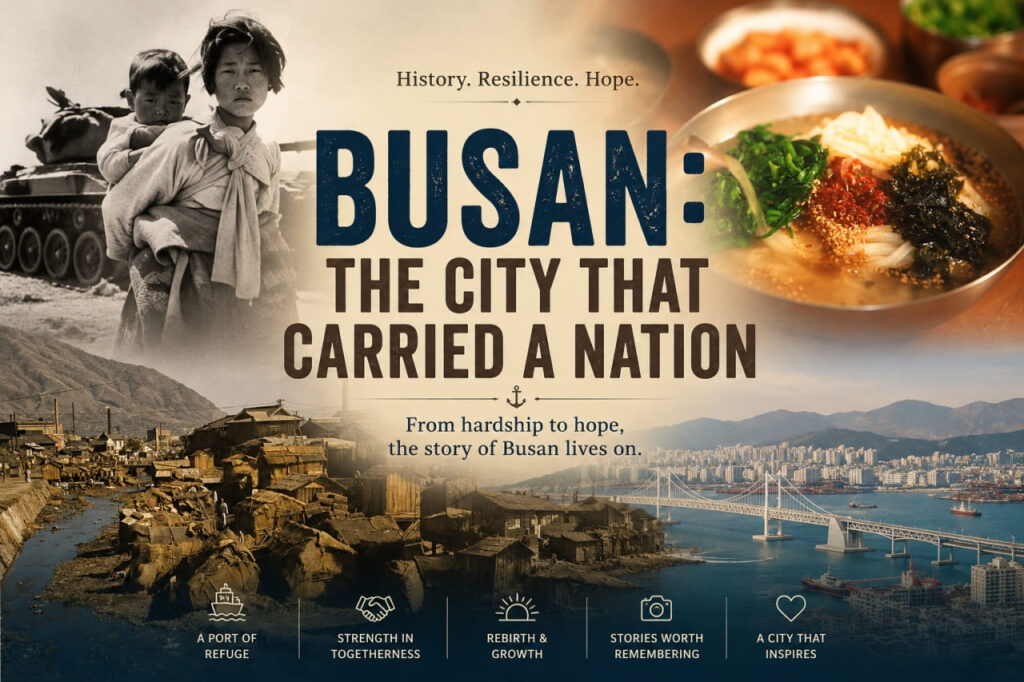
Busan: From Refuge to Global City
During the darkest days of the Korean War, Busan became the city that carried a nation.
Korean War & Busan
In the darkest winter of the Korean War, when Seoul had fallen and much of the peninsula lay in ruins, Busan became the nation’s final sanctuary.
Between 1950 and 1953, millions of refugees poured into the crowded southern port city carrying little more than family photographs, blankets, and hope. Hillsides rapidly transformed into endless terraces of makeshift homes, while the harbor became a lifeline connecting a fractured nation to the outside world.
For many Koreans, Busan was not merely a city of refuge — it was the place where modern Korea survived.
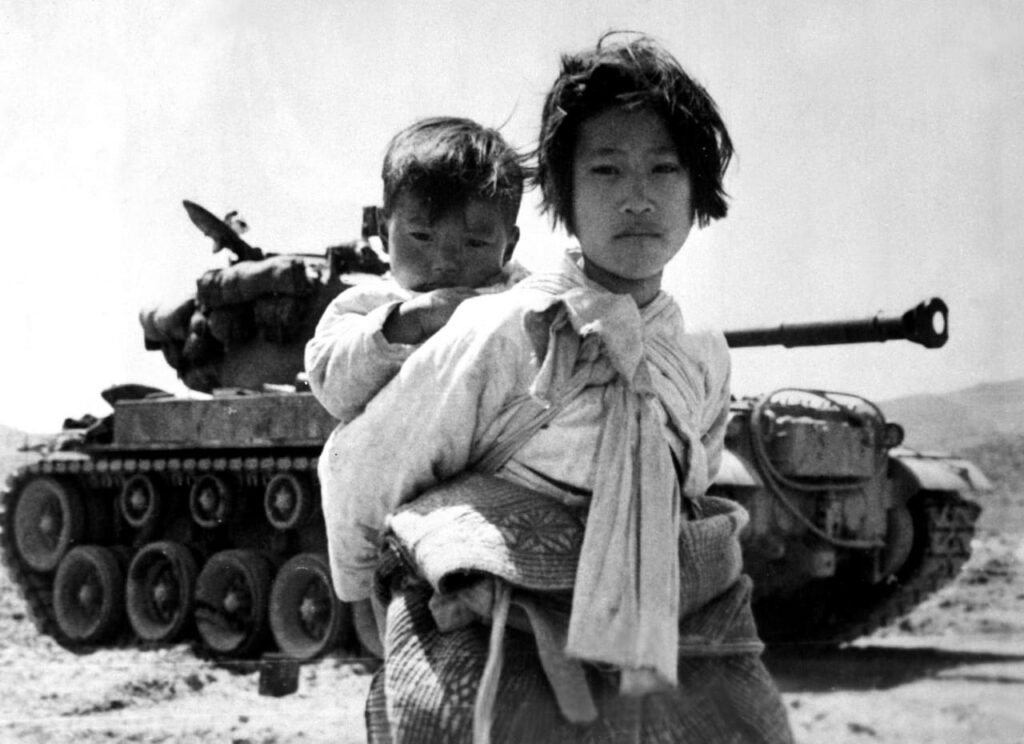
Even amid hunger and uncertainty, life continued.
Markets overflowed with voices from every corner of the peninsula, temporary schools opened in abandoned buildings, and narrow alleyways filled with resilience rather than despair. The spirit that defines Busan today — unpretentious, resilient, fiercely alive — was forged during those years of hardship.
After the war, while Seoul reclaimed its position as the political and economic center of the country, Busan evolved into something equally significant: Korea’s maritime soul. Its vast port helped drive the nation’s astonishing economic rise, while generations of displaced families transformed the city into a living mosaic of regional cultures, dialects, and memories.
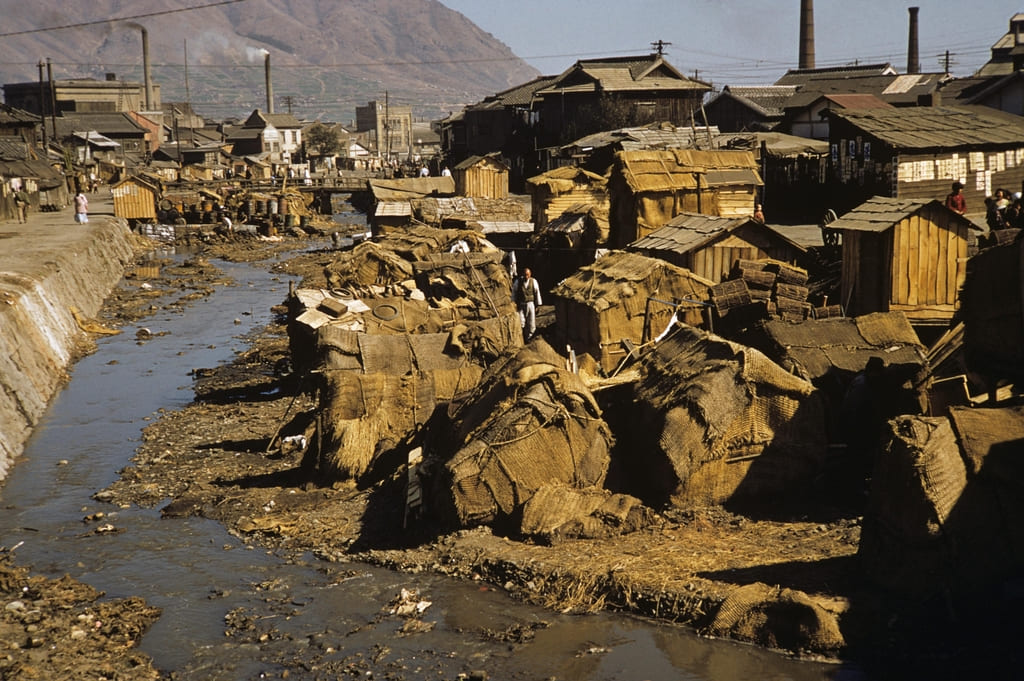
Today, Busan stands in striking contrast to the polished intensity of Seoul. Here, mountains descend into the sea, fishing villages coexist beside luxury towers, and traces of wartime history quietly linger between vibrant seafood markets and cinematic coastal roads. It is a city shaped not only by commerce and beauty, but by survival itself.
To walk through Busan is to encounter a different rhythm of Korea — one born from refuge, endurance, and the unwavering determination to begin again.

Gupo Guksu noodle – Refugees’ Lifeline
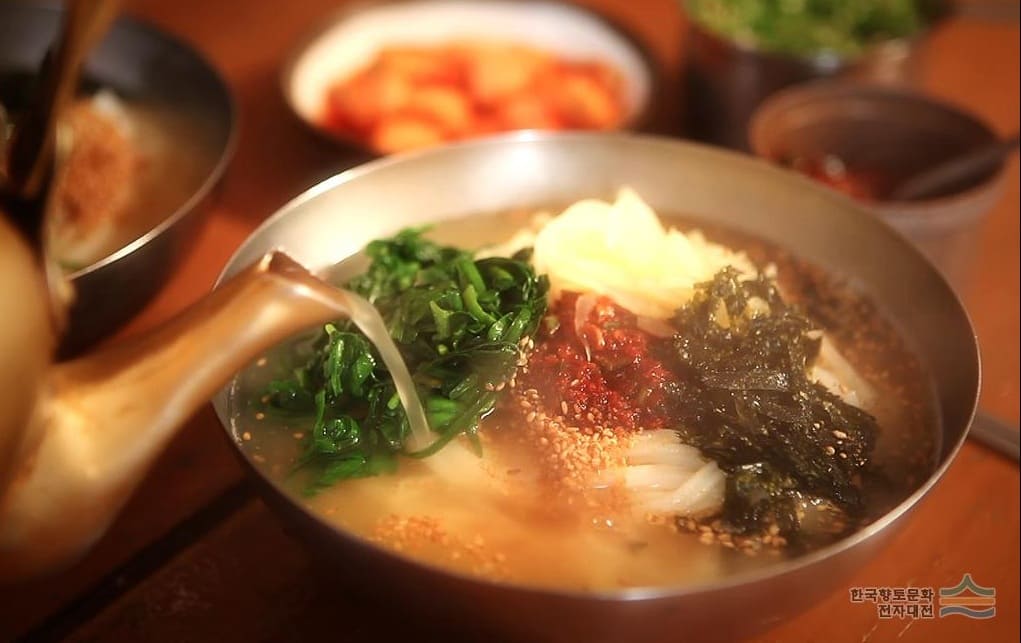
One of the most enduring stories from wartime Busan can still be tasted in a humble bowl of noodles.
As refugees flooded into the city during the Korean War, food was painfully scarce. Wheat flour provided through foreign aid became one of the few reliable ingredients available to displaced families struggling to survive. In the northern district of Gupo, refugees began crafting thin wheat noodles by hand — inexpensive, filling, and capable of feeding entire families with almost nothing.
What began as a necessity of survival eventually became what Koreans now know as “Gupo Guksu,” one of Busan’s most beloved culinary traditions. Even today, the simple texture of those noodles carries the memory of a generation that endured war, separation, and poverty with quiet resilience.
Location of Gupo Market
Similar stories echo throughout the city. In the crowded alleys of Jagalchi Market, refugee women — many of whom had lost husbands, homes, or entire families — sold fish and seafood from wooden stalls before dawn, helping rebuild both their households and the city itself. Their fierce determination gave rise to the legendary image of Busan’s market ajummas: outspoken, resilient, and impossible to intimidate.
Meanwhile, the steep hillside neighborhoods that visitors now photograph for their colorful beauty were once desperate refugee settlements built from scrap wood, military debris, and hope. Places such as Gamcheon Culture Village trace their origins to communities formed by displaced families seeking any patch of land where they could begin again.
These stories remain deeply woven into Busan’s identity. Beneath the beaches, luxury hotels, and cinematic skyline lies the memory of a city that once carried an entire nation on its shoulders — and somehow transformed hardship into warmth, culture, and enduring pride.

From Refuge to Global City: 9 Essential Stops in Busan
- UN Memorial cemetery↗
- Mandeok Lego Village↗
- Gupo market↗
- Gamcheon Culture Village↗
- Jagalchi market↗
- Gwangbok-dong↗
- Gwangalli beach↗
- Haeundae beach↗
- Haedong Yonggungsa Temple↗
🌊 Busan in Film & Drama
More than a beach destination, Busan is a city shaped by resilience, cinema, and the sea.
🎬 Busan in Film & Drama
- Train to Busan (2016, 부산행) Starring: Gong Yoo, Ma Dong-seok
Korea’s most internationally recognized thriller, ending in Busan’s symbolic refuge - Haeundae (2009, 해운대) Starring: Sul Kyung-gu, Ha Ji Won
A blockbuster disaster film showcasing Korea’s most famous beach - Life on Mars (2018, 라이프 온 마스) Starring: Jung Kyung-ho
Retro Busan streets, ports & old neighborhoods recreated through a time-travel mystery
🌊 The Spirit of Busan
- Busan International Film Festival (BIFF) Asia’s premier film festival and the cultural heart of Korean cinema
- Jagalchi Market Korea’s largest seafood market and the soul of Busan’s maritime culture
- Gamcheon Culture Village Colorful hillside homes shaped by Busan’s refugee history after the Korean War
🛏️ Hotels in Busan
Choose your preferred booking partner.





You May Also Like
- Kdrama Hotels: Stay Where the Stories Were Filmed (Part 1)
- Jeju — Waiting Beyond the Horizon
- Best 25 Hotels in Jeju by Area
- Stanford Hotels Korea – Trusted Hotels from Seoul to Jeju
- Suncheon – Where Korea Slows Down
- Tteok Trail: Where Korea Pauses
More to Explore on KHOREA
Discover more stories across Korea — choose a category that inspires you.