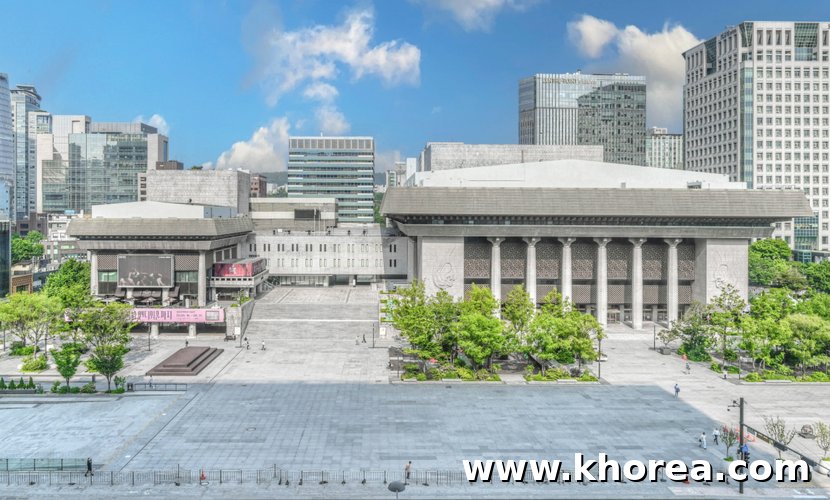
Sejong Center for the Performing Arts, a cultural landmark in the heart of Gwanghwamun, Seoul
In a city celebrated for its seamless blend of ancient tradition and cutting-edge modernity, few places capture this duality as elegantly as the Sejong Center for the Performing Arts. Positioned along the grand boulevard of Sejongdaero in the historic Gwanghwamun district, the venue stands as both a cultural landmark and a gateway into Korea’s evolving artistic identity.
For travelers seeking more than sightseeing—for those drawn to atmosphere, narrative, and cultural depth—the Sejong Center offers an experience that extends well beyond the stage.

Where Seoul’s Cultural Narrative Unfolds
Named after King Sejong the Great, the visionary ruler behind the Korean alphabet, the center carries a legacy that resonates deeply within the nation’s cultural consciousness. Its architecture reflects this significance: understated yet monumental, with subtle references to traditional Korean design embedded within a modern framework.
Built in 1978 and reborn as a foundation in 1999, it has been dubbed the cradle of Korean performance culture and played an important role as a hub for Seoul’s performance culture and arts.
The surrounding district further enhances its appeal. Just steps away lie historic palaces, expansive public squares, and museums that collectively form the symbolic core of Seoul. Here, past and present coexist—not as contrast, but as continuity.

A Stage for Both Heritage and Innovation
What distinguishes the Sejong Center is not only its scale but the breadth of its programming. Throughout the year, the venue hosts a diverse lineup of performances that speak to a global audience while remaining rooted in Korean tradition.
Visitors may encounter :
* Orchestral performances and classical concerts
* Opera and ballet productions with international collaborations
* Traditional Korean music and dance, rich in historical storytelling
* Contemporary theater and experimental works reflecting modern Seoul
This curatorial balance has positioned the venue as a cultural bridge—one that connects local heritage with global artistic dialogue.

Beyond the Performance: An Immersive Cultural Stop
Even outside performance hours, the Sejong Center remains a compelling destination. Its interiors invite quiet exploration, while the surrounding Gwanghwamun area offers a dynamic urban landscape shaped by history and civic life.
Travelers often integrate their visit with nearby attractions, creating a cultural itinerary that flows naturally from royal palaces to modern galleries, from open plazas to refined performance halls.
Seasonal festivals, outdoor events, and public installations further blur the line between formal performance and everyday cultural experience.

A Defining Stop in Seoul’s Cultural Journey
As Seoul continues to emerge as a global cultural capital, venues like the Sejong Center play a defining role in shaping how the city is experienced. No longer limited to traditional tourism, visitors are increasingly seeking meaningful, curated encounters—and the performing arts offer precisely that.
In this context, the Sejong Center is not simply a venue. It is an entry point into Korea’s artistic soul, where each performance becomes part of a larger story—one that visitors are invited not just to observe, but to feel.
📍 How to Get There
🚇 Subway
Line 5 : Gwanghwamun Station (Exit 1, 8) → 2–3 min walk
Line 3 : Gyeongbokgung Station (Exit 6, 경복궁역) → 10 min walk
🚖 Taxi
Say or show this: “Sejong Munhwa Hoegwan (세종문화회관)”
✈️ From Incheon Airport
AREX → Gongdeok Station (Subway, 공덕역)→ Gwanghwamun Station (Exit 1, 8) → 2–3 min walk
🎬 K-Dramas Filmed at Sejong Center
- My Love from the Star (2013, 별에서 온 그대) Starring: Kim Soo-hyun, Jun Ji-hyunGrand cultural venue & city landmark scenes
- Encounter (2018, 남자친구) Starring: Park Bo-gum, Song Hye-kyoElegant urban walks & emotional moments
- Secret Love Affair (2014, 밀회) Starring: Kim Hee-ae, Yoo Ah-inClassical music & performance-inspired scenes
🎥 Films & Performance Media
- Musicals & Performances Featuring: Cho Seung-woo, Ock Joo-hyunIconic Korean musical productions
- Concert Hall & Classical Events Symphony orchestras & grand performances
- Gwanghwamun Night Views City lights, culture & architecture
🛏️ Hotels near Sejong Center
Choose your preferred booking partner.





You May Also Like
- Feel the sensation: Gugak Korean traditional music
- The Ceramic Trail of Korea – Where Earth Meets Fire and Time
- National Museum of Korea Guide
- Kdrama Hotels: Stay Where the Stories Were Filmed (Part 1)
- Korean Buddhism—The Soul of Serenity
- Seoul’s Five Grand Palaces & Myeongdong Itinerary
More to Explore on KHOREA
Discover more stories across Korea — choose a category that inspires you.