Traditional Korean Games in Korea
Childhood Games, Reimagined
Long before they appeared on screen, the games in Squid Game were part of everyday childhood in South Korea—simple, tactile, and deeply social.
For travelers seeking a more interactive Korea cultural experience, these traditional games offer something refreshingly different: not observation, but participation. They are easy to learn, unexpectedly competitive, and rooted in a shared sense of play.

Ddakji: The Art of Precision (딱지 치기)
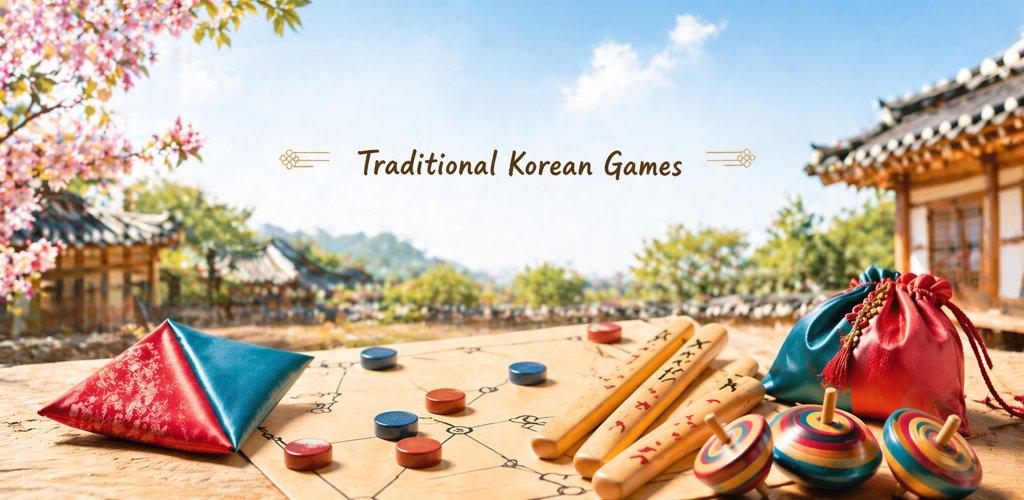
Ddakji is deceptively simple. Players throw a folded paper tile in an attempt to flip their opponent’s piece—a game of angle, force, and timing.
It’s often the first introduction for visitors searching Korean traditional games, and one of the most satisfying to master.
Today, you can still find ddakji demonstrations and workshops in cultural spaces around Seoul, particularly in traditional districts.

Dalgona: A Sweet Challenge (달고나)
Perhaps the most visually recognizable, dalgona is a brittle sugar candy stamped with a shape. The goal is to carve it out without breaking it—a test of patience rather than strength.
In areas like Myeongdong, versions of this nostalgic treat can still be found, connecting modern street culture with childhood memory.
For those exploring Korean street food experiences, dalgona offers both flavor and play.

Tug of War: Strength in Rhythm (줄다리기)
Tug of war in Korea goes beyond a simple contest of strength—it becomes a collective ritual.

In traditional settings, massive ropes are used, and entire communities participate. The rhythm, coordination, and energy transform the game into something almost ceremonial.
For visitors interested in traditional Korean festivals, this is where play meets cultural expression.

Squid Game : The Original Playground Game (오징어 게임)
The game that inspired the series takes its name from the squid-shaped drawing on the ground.

It combines elements of tag, strategy, and territory control—simple in concept, but surprisingly dynamic. While less commonly played today, it remains a symbolic representation of Korean childhood games.
For travelers, it offers a deeper understanding of how something so minimal can become so immersive.

Where to Experience Traditional Korean Games
These games are no longer confined to memory.
In cultural villages, museums, and seasonal festivals, visitors can experience them firsthand. Areas like Bukchon Hanok Village and various cultural centers in Seoul occasionally host interactive programs.
For those building a things to do in Seoul list, this is one of the most engaging ways to connect with local culture.

Why It Matters Now
What makes these games resonate today is not nostalgia alone.
They remind us that culture does not always need complexity to be meaningful. A piece of paper, a line on the ground, a shared moment of competition—these are the elements that endure.
And in experiencing them, even briefly, travelers move from watching Korea
to playing within it.
🕹 How to Play: Korean Games from Squid Game
🟥 Ddakji (딱지치기)
What it is: A traditional paper-flipping game played by hitting your opponent’s folded tile.
Tip: Angle and speed matter more than strength.
🍯 Dalgona (달고나 뽑기)
What it is: A sugar candy challenge where you carve out a shape without breaking it.
Tip: Patience beats speed. Cracks = failure.

🦑 Squid Game & Traditional Play Culture
🦑 Squid Game & Filming Inspiration
- Squid Game (2021, 2024- 오징어 게임) Starring: Lee Jung-jae, Jung Ho-yeon Iconic Korean childhood games like ddakji, dalgona, and tug-of-war
- Seoul Children’s Grand Park Playground Real-life playground atmosphere similar to childhood game settings
- Traditional Game Experience (Seoul) Try ddakji, jegi, and other classic Korean games
🎬 Similar Themes & Survival Dramas
- Alice in Borderland (2020) Starring: Kento YamazakiHigh-stakes survival games & psychological tension
- The 8 Show (2024) Starring: Ryu Jun-yeolKorean survival concept with social commentary

🛏️ Hotels near Bukchon
Choose your preferred booking partner.





You May Also Like
- Why Visit South Korea in 2026: A Complete Luxury Korea Travel Guide
- Traditional Korean Culture
- Kdrama Hotels: Stay Where the Stories Were Filmed (Part 1)
- Myeongdong to Ikseon-dong guide
- National Museum of Korea Guide
- The Layered City: A Journey Through Seoul’s Hidden Histories
- Seoul’s Five Grand Palaces & Myeongdong Itinerary
More to Explore on KHOREA
Discover more stories across Korea — choose a category that inspires you.