An editorial exploration of Korean pronunciation and Seoul through language
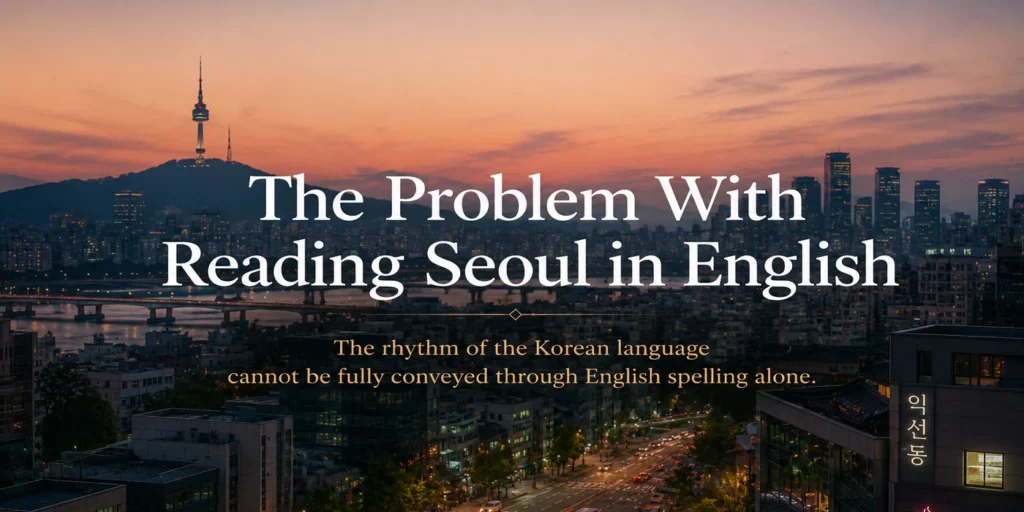
The rhythm of the Korean language cannot be fully conveyed through English spelling alone.
Seoul is full of neighborhood names that appear simple in English but sound entirely different when spoken aloud in Korean.
Seoul becomes “Se-ul.”
Ikseon is often read as “Ik-se-on.”
Mangwon becomes “Man-gwon.”
Yet to Koreans, these names carry entirely different rhythms — softer consonants, shorter vowels, and centuries of linguistic history hidden beneath modern Roman letters.
The issue is not that foreign visitors pronounce Korean incorrectly.
It is that Romanization was never designed to fully capture how Korean actually sounds.

Why did Korea use Chinese characters?
Long before Hangul existed, Korea used Hanja (Chinese characters, 한자) — adapted into Korean pronunciation and scholarship. Across much of East Asia, written Chinese once functioned as a shared literary and administrative language, much like Latin did in medieval Europe.
But Korea did not simply “borrow” Chinese writing unchanged. Even during that period, the intellectual class was concerned that the Korean language could not be perfectly expressed using Chinese characters. This is because the unique words of Hangul contained expressions and meanings that could not be represented by Hanja, which is an ideographic script. For example, while Korean adjectives translated into a single word when written in Chinese characters, Korean and Hangul can express different emotions or states through numerous variations of the same word.
This historical layering is part of what makes Korean place names feel unfamiliar in English. Beneath the Roman letters are older systems of sound, meaning, and rhythm that do not map neatly onto English phonetics.

Even though Hangul was created, why did Korean continue to use Chinese characters?
Even after King Sejong introduced Hangul in the 15th century, Hanja remained deeply embedded in Korean society for centuries. Government records, literature, newspapers, scholarship, and legal documents continued to rely heavily on Chinese characters long after Hangul’s creation.
One reason was that the Yangban aristocracy and scholarly elite continued to regard Classical Chinese as the language of education, administration, and intellectual prestige. As a result, Hangul was often viewed as a practical vernacular script rather than a formal literary language during much of the Joseon period.
For centuries, Hangul became especially important among commoners and women seeking greater access to reading and writing outside elite scholarly circles.
Korea therefore continued to rely on a mixed-script system combining Hangul and Hanja well into the modern era, similar to the way Japanese still combines kana and kanji today.
Korean-style Chinese character pronunciation
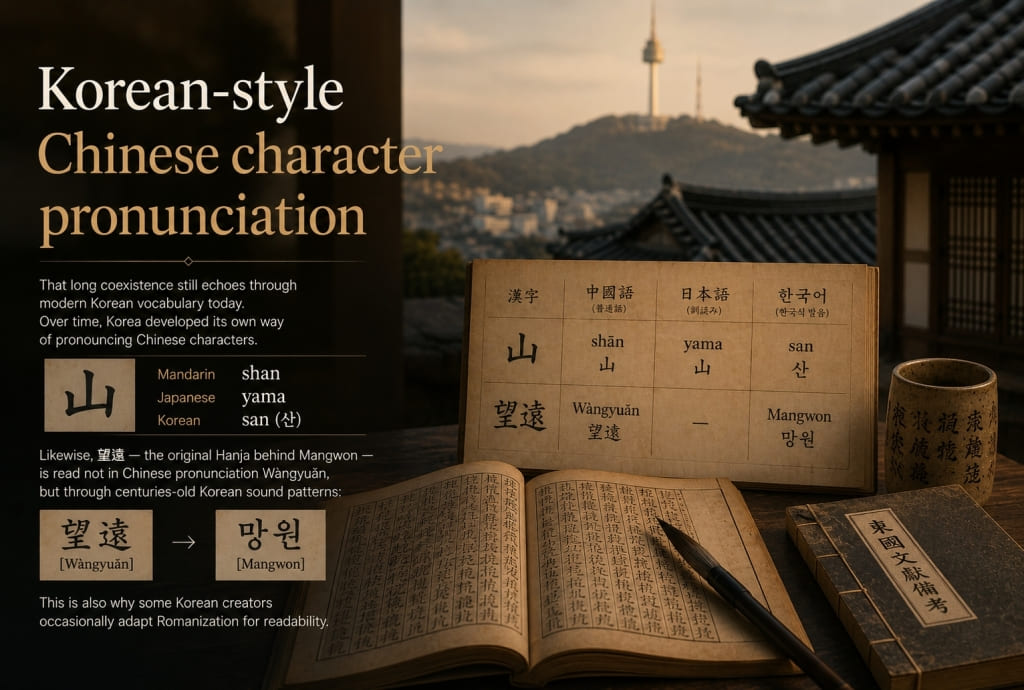
That long coexistence still echoes through modern Korean vocabulary today. Over time, Korea developed its own way of pronouncing Chinese characters.
The character 山, for example, is pronounced “shan” in Mandarin, “yama” in Japanese, and “san” (산) in Korean.
Likewise, 望遠 — the original Hanja behind Mangwon — is read not in Chinese pronunciation Wàngyuǎn, but through centuries-old Korean sound patterns: Mangwon (망원).
This is also why some Korean creators occasionally adapt Romanization for readability.
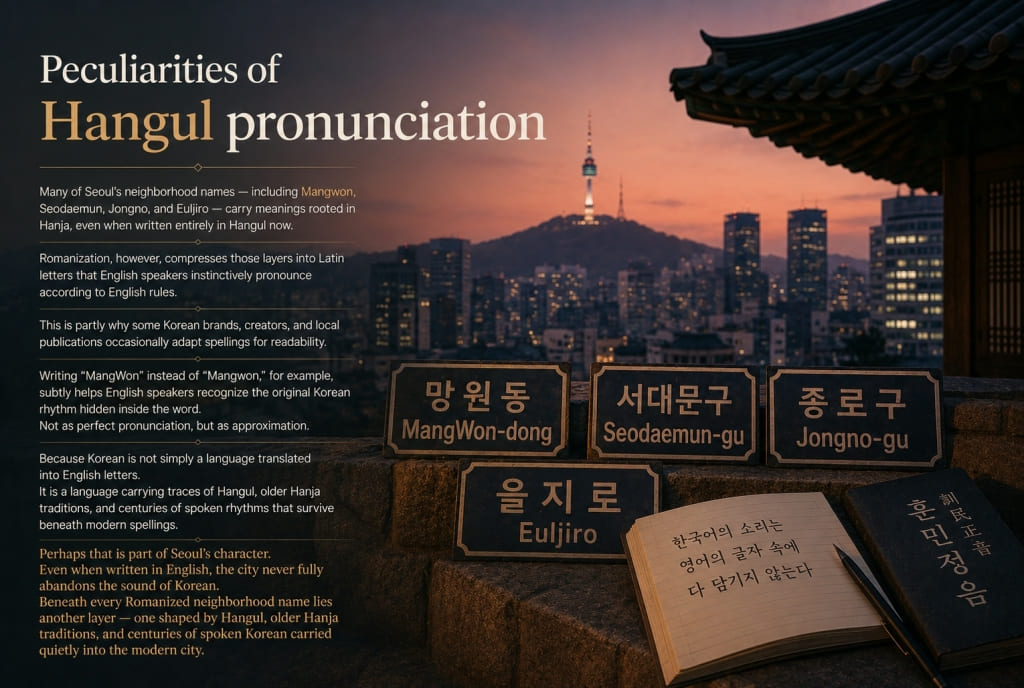
Peculiarities of Hangul pronunciation
Many of Seoul’s neighborhood names — including Mangwon, Seodaemun, Jongno, and Euljiro — carry meanings rooted in Hanja, even when written entirely in Hangul now.
Romanization, however, compresses those layers into Latin letters that English speakers instinctively pronounce according to English rules.
This is partly why some Korean brands, creators, and local publications occasionally adapt spellings for readability.
Writing “MangWon” instead of “Mangwon,” for example, subtly helps English speakers recognize the original Korean rhythm hidden inside the word.
Not as perfect pronunciation, but as approximation.
Because Korean is not simply a language translated into English letters.
It is a language carrying traces of Hangul, older Hanja traditions, and centuries of spoken rhythms that survive beneath modern spellings.
Perhaps that is part of Seoul’s character itself.
Even when written in English, the city never fully abandons the sound of Korean.
Beneath every Romanized neighborhood name lies another layer — one shaped by Hangul, older Hanja traditions, and centuries of spoken Korean carried quietly into the modern city.
Refernce :https://www.korean.go.kr/front_eng/roman/roman_01.do
More to Explore on KHOREA.COM
Discover more stories across Korea — choose a category that inspires you.