
Introducing Jeongeup
Located in the southwestern heart of South Korea, Jeongeup (정읍시) is a city where dramatic mountain landscapes, ancient poetry, and pivotal modern history meet. Best known across East Asia for the fiery crimson maples of Naejangsan National Park, Jeongeup is also closely associated with the Donghak Peasant Revolution, a pivotal movement in Korea’s modern social history, and centuries-old tea traditions.

Why Visit Jeongeup
- Korea’s Premier Autumn Destination: Naejangsan is one of Korea’s most spectacular autumn foliage destinations, famed for its petite, vibrant “baby maple” (Aegi-danpung) leaves.
- A Cradle of Modern Korean Social Reform: Jeongeup was a major center of the Donghak Peasant Revolution of 1894, a movement that challenged corruption and inequality and helped shape Korea’s modern history.
- Rich Literary & Tea Heritage: Jeongeupsa, an ancient song from the Baekje period in which a wife waits beneath the moon for her traveling merchant husband.

Core Dimensions of Jeongeup
1. Geography & Climate
Jeongeup lies in southwestern Jeollabuk-do, positioned between the fertile Honam Plain and the rugged peaks of the No-ryeong Mountain Range.
- Topography: Low-lying western plains ideal for agriculture, flanked to the south and east by the sharp, picturesque ridge lines of Naejangsan National Park.
- Climate: Four distinct seasons. Summers are warm and humid, while late October to mid-November brings crisp, dry air and ideal foliage conditions. Winters frequently see heavy, picturesque snowfall across the mountain passes.

2. History
Jeongeup holds deep historical significance across multiple eras of the Korean peninsula:
- Baekje Kingdom Roots: Immortalized in Jeongeupsa, where a wife waits on a hill under the moonlight for her traveling merchant husband.
- Historic Scholar Academies: Museongseowon, a Confucian academy and UNESCO World Heritage site, served as an important center of education and community life during the Joseon period.
- Donghak Peasant Revolution (1894): Led by General Jeon Bong-jun, local farmers rose against feudal corruption and foreign encroachment at Gobu, igniting a national movement for equality and modernization.

3. Culture & Heritage
- Ssanghwa-cha Culture: Jeongeup is famous for brewing Ssanghwa-cha, a rich traditional herbal tonic tea simmered in earthenware pots with medicinal herbs, chestnuts, and pine nuts.
- Gujeolcho (Siberian Chrysanthemum) Festival: Every October, the pine forests around Okjeongho Lake turn white with blooming Gujeolcho flowers.

Top Attractions
| Attraction | Category | Key Highlights |
|---|---|---|
| Naejangsan National Park | Nature / Hiking | The tranquil Uhwajeong Pavilion reflected in a mountain pond, the scenic cable car, and a maple-lined path leading to Naejangsa Temple. |
| Museongseowon Confucian Academy | UNESCO Heritage | A remarkably well-preserved Neo-Confucian academy that functioned as a cultural community hub without royal exclusivity. |
| Donghak Peasant Revolution Memorial Hall | History / Museum | Historic battle sites, exhibition halls, and memorials commemorating the 1894 peasant rebellion. |
| Jeongeup Ssanghwa-cha Street | Culinary / Culture | A dedicated alley near the city center lined with heritage tea houses serving thick, piping-hot herbal tonic in heated ceramic bowls. |
| Gujeolcho Theme Park | Seasonal Nature | A 12-hectare park featuring approximately 5 hectares of pine forest carpeted with snow-white Gujeolcho flowers, along with lake vistas and walking trails. |

Local Flavors & Dining
- Ssanghwa-cha (Herbal Restorative Tea): Slow-simmered for over 10 hours using angelica root, cnidium, rehmannia, and cinnamon, garnished generously with chestnuts, ginkgo nuts, and dried jujubes.
- Danpung Hanwoo (Native Korean Beef): High-grade regional beef raised on specialized local feed, renowned for its tender marbling.
- Sanchae Hanjeongsik (Full Mountain Greens Table): Served in restaurants clustered outside the Naejangsan park gates, featuring over 20 side dishes made from wild mountain vegetables, deodeok root, and grilled local fish.

Getting There from Seoul (KTX High-Speed Train)
The fastest and most convenient route from Seoul to Jeongeup is via the Honam KTX Line.
[KTX High-Speed Train]
Seoul Station / Yongsan Station ──(Honam KTX / ~1 hr 25 min – 1 hr 40 min)──> Jeongeup Station
- Departure Hub:Yongsan Station offers the most frequent Honam KTX departures (trains depart almost hourly). Select trains also run from Seoul Station.
- Travel Time: Approximately 85 to 100 minutes.
- Local Connection: From Jeongeup Station, City Bus No. 171 runs directly to the Naejangsan National Park ticket office in roughly 30–45 minutes, or you can take a taxi (~30 minutes).
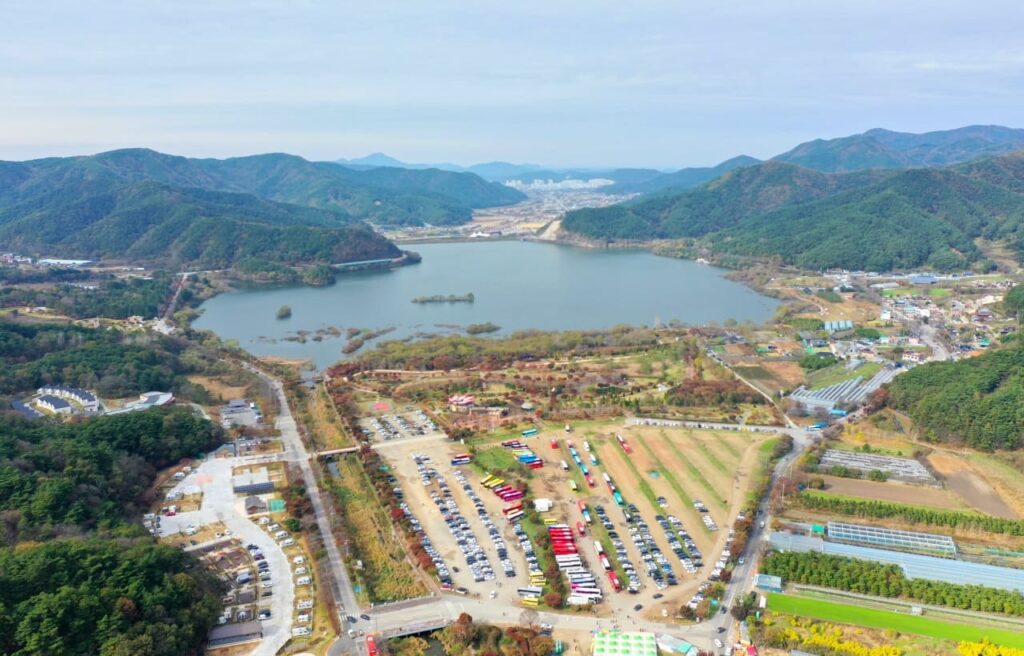
Where autumn paints the mountains,
an ancient song still echoes beneath the moon.
🎬 K-Dramas & Movies Connected with Jeongeup
- The Nokdu Flower (2019, 녹두꽃) Starring: Yoon Shi-yoon, Han Ye-ri, Cho Jung-seok,
Set against the backdrop of the Donghak Peasant Revolution that shook Joseon in 1894, a heartbreaking story of half-brothers forced to point their swords at each other, divided between the peasant army and the government forces. - The Haunted Palace (2025, 귀궁) Starring: Yook Sung-jae, Kim Ji-yeon (Bona)
Several scenes were filmed at Songchambong Joseon Village in Jeongeup, whose authentic late-Joseon setting perfectly matched the historical fantasy drama. - The King’s Affection (2021, 연모) Starring: Park Eun-bin, Rowoon
Jeongeup’s traditional scenery and nearby heritage sites evoke the timeless beauty often seen in Joseon-era dramas. - Mr. Sunshine (2018, 미스터 션샤인) Starring: Lee Byung-hun, Kim Tae-ri
The story’s themes of change, patriotism, and sacrifice resonate with Jeongeup, home to important sites of the Donghak Peasant Revolution. - The Age of Shadows (2016, 밀정) Starring: Song Kang-ho, Gong Yoo
Although not filmed in Jeongeup, its historical atmosphere pairs naturally with nearby Donghak heritage sites and Korea’s modern history. - When Life Gives You Tangerines (2025, 폭싹 속았수다) Starring: IU, Park Bo-gum
Like Jeongeup, the drama beautifully captures the rhythm of Korea’s changing seasons and the quiet warmth of everyday life.
Hotels in Jeongeup
Stay within walking distance of Seoul’s most popular shopping streets.



You May Also Like
- Korea in Autumn: A Curated Travel Guide 2026
- Healing Korea─Muju: The Eco-Haven of Korea
- Iksan—Ancient Capital to Transit Hub
- Namwon – Memory of Emotion
- Jeonju Hanok Village: Korea’s Most Elegant Cultural Escape by KTX
- Buyeo – Invitation to a slower world
- Gyeongju—The City Where Korea Remembers Itself
- Kdrama Hotels: Stay Where the Stories Were Filmed (Part 3)
- 2027 FISU Universiade—When the World Comes to Korea | KHOREA
- From Kingdoms To Korea — History Timeline
More to Explore on KHOREA
Discover more stories across Korea — choose a category that inspires you.