Discover traditional Korean culture through hanok stays, hanbok experiences, tea ceremonies in Seoul.
A Timeless Experience in Modern Korea
Tradition, Reimagined
There are places where tradition is preserved behind glass.
And then there is South Korea—where tradition is not only preserved, but lived, refined, and reinterpreted.
For travelers seeking a deeper Korea cultural experience, the country offers something rare: not performances staged for visitors, but rituals and aesthetics still woven into everyday life.

The Elegance of Hanok Living
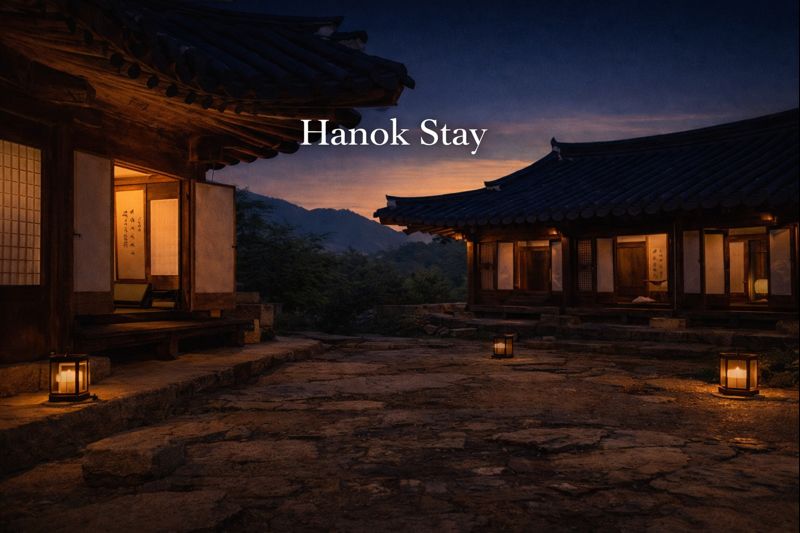
In neighborhoods like Bukchon Hanok Village↗, traditional Korean homes—hanok (한옥)—stand quietly between the city’s modern lines.
Their beauty lies in restraint: natural materials, soft light, and a deliberate relationship with space. Staying in a hanok is not about nostalgia; it is about experiencing a slower, more intentional way of living.
For those searching for traditional Korean houses or hanok stays in Seoul, this is where the past becomes personal.

Wearing History: The Modern Hanbok
At Gyeongbokgung Palace, visitors dressed in hanbok↗ move through palace courtyards with a quiet grace.
The traditional Korean dress has evolved—lighter fabrics, modern silhouettes—but its essence remains unchanged. It is less a costume, more a continuation of identity.
For travelers, wearing hanbok offers something unexpectedly powerful: a way to step into the rhythm of history, rather than observe it.

The Ritual of Tea
Korean tea culture is defined not by complexity, but by intention.
In a traditional tea house, time slows. Each movement—pouring, serving, tasting—is deliberate. The experience becomes less about the tea itself and more about presence.
For those exploring Korean tea culture, it offers a quiet counterpoint to the energy of Seoul.

Temple Stays: Silence as Experience
Beyond the cities, Korea’s temples offer one of its most profound cultural experiences.
A temple stay introduces visitors to meditation, monastic meals, and early morning rituals. It is not designed as an escape, but as an immersion.
For travelers searching for a unique Korea experience, this is perhaps the most transformative—an encounter with stillness in a country defined by motion.

Craft, Detail, and Everyday Beauty
Korean craftsmanship is rooted in subtlety.
From ceramics to hanji paper, the emphasis is not on decoration, but on balance and form. These objects are not just artifacts—they are extensions of a philosophy that values harmony over excess.
In areas like Insadong↗, this tradition continues through galleries, workshops, and curated shops.

Tradition, as a Living Experience
What defines Korean culture is not its age, but its continuity.
You don’t need to seek it out—it reveals itself in quiet moments:
in the architecture, in the rituals, in the pace of everyday life.
And perhaps that is what makes it unforgettable.
Not something you simply learn about,
but something you briefly become part of.

🏯 Korean Traditional Culture Picks
🎬 Historical K-Dramas
- Love in the Moonlight (2016, 구르미 그린 달빛) Starring: Park Bo-gum, Kim Yoo-jungHanbok aesthetics & palace romance
- Jewel in the Palace (2003, 대장금) Starring: Lee Young-aeRoyal cuisine, tea culture & traditional medicine
- Mr. Sunshine (2018, 미스터 션샤인) Starring: Lee Byung-hun, Kim Tae-riHanok architecture & late Joseon aesthetics
🎥 Historical Films
- The King and the Clown (2005, 왕의 남자) Starring: Lee Joon-gi, Gam Woo-sungTraditional performance & royal court culture
- Masquerade (2012, 광해) Starring: Lee Byung-hunPalace politics & royal life
- Little Forest (2018, 리틀 포레스트) Starring: Kim Tae-riSlow living, food & seasonal Korean lifestyle
🛏️ Hotels in Myeongdong
Choose your preferred booking partner.





You May Also Like
- Tteok Trail: Where Korea Pauses
- The Ceramic Trail of Korea
- Namwon – Memory of Emotion
- Buyeo – Invitation to a slower world
- Andong – Where Korea Learned to Listen
More to Explore on KHOREA
Discover more stories across Korea — choose a category that inspires you.